
The Rainbow Bridge Poem: Meaning, Author & Gentle Memorial Resources
Read the widely shared Rainbow Bridge poem, learn the verified story of Edna Clyne-Rekhy and her Labrador, Major, explore what the poem means, and find gentle ways to remember your pet through printable resources, a quiet ritual, or a personal tribute.
Written in 1959 and circulated anonymously for decades; Edna Clyne-Rekhy’s authorship was traced by art historian Paul Koudounaris and reported by National Geographic in 2023.
What is the Rainbow Bridge poem?
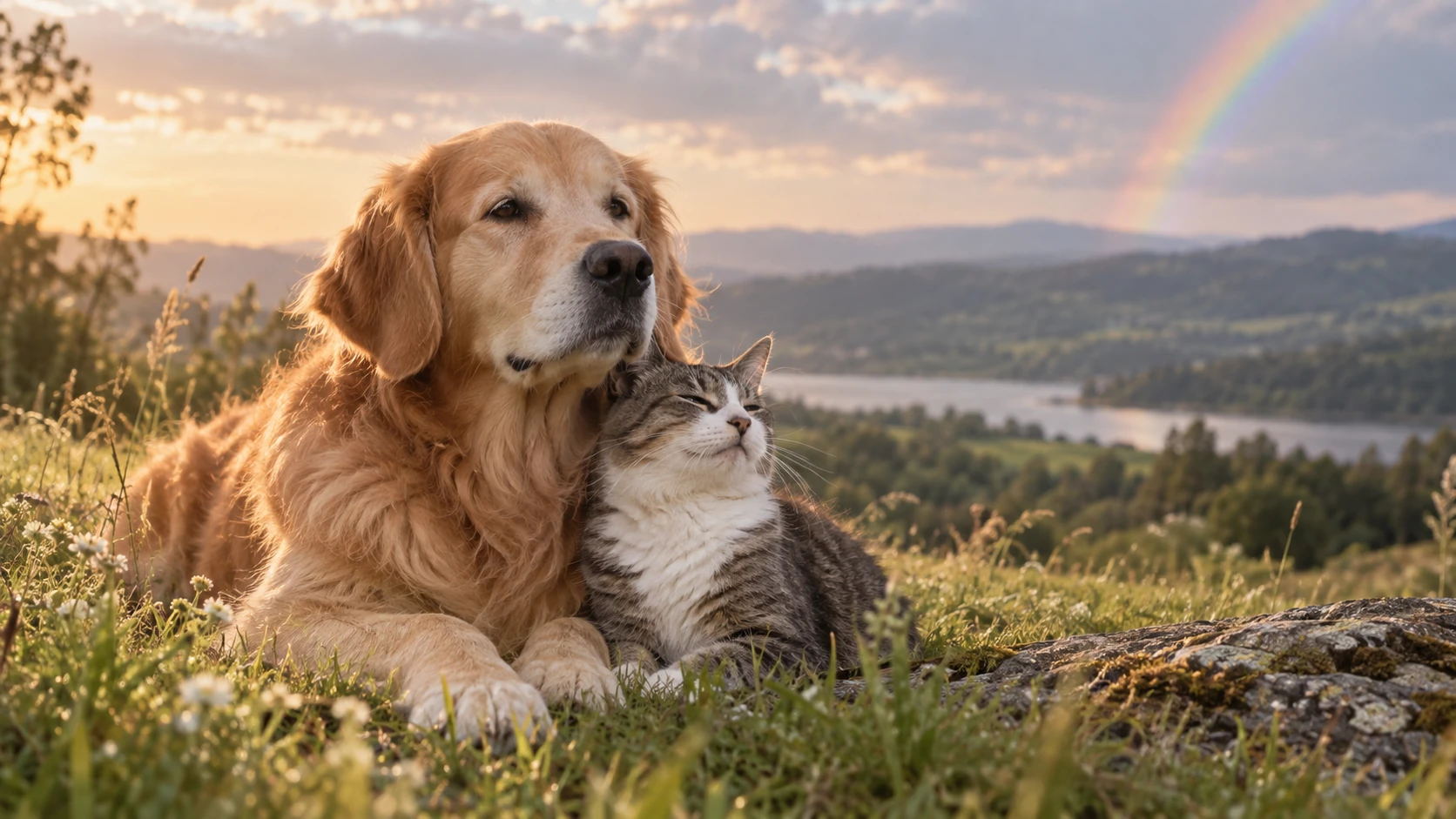
The Rainbow Bridge poem is a pet-loss prose poem that imagines beloved animals restored to health in a peaceful meadow, waiting to be reunited with the people who loved them. It was written in 1959 by Scottish artist Edna Clyne-Rekhy after the death of her Labrador, Major. For many pet families, the poem offers a symbolic picture of comfort, remembrance, and reunion.
If your loss is very recent: you may prefer to begin with our first-hours guide after a dog dies.
On this page
The poem
The Rainbow Bridge Poem — Widely Shared Version
The poem circulated anonymously for decades, and several versions now exist. The text below is the widely shared version already used on this page; wording differs slightly from Edna Clyne-Rekhy’s surviving 1959 manuscript.
Just this side of heaven is a place called Rainbow Bridge.
When an animal dies that has been especially close to someone here, that pet goes to Rainbow Bridge. There are meadows and hills for all of our special friends so they can run and play together. There is plenty of food, water and sunshine, and our friends are warm and comfortable.
All the animals who had been ill and old are restored to health and vigor. Those who were hurt or maimed are made whole and strong again, just as we remember them in our dreams of days and times gone by. The animals are happy and content, except for one small thing; they each miss someone very special to them, who had to be left behind.
They all run and play together, but the day comes when one suddenly stops and looks into the distance. His bright eyes are intent. His eager body quivers. Suddenly he begins to run from the group, flying over the green grass, his legs carrying him faster and faster.
You have been spotted, and when you and your special friend finally meet, you cling together in joyous reunion, never to be parted again. The happy kisses rain upon your face; your hands again caress the beloved head, and you look once more into the trusting eyes of your pet, so long gone from your life but never absent from your heart.
Then you cross Rainbow Bridge together…
Attribution: Edna Clyne-Rekhy, written in 1959 after the death of her Labrador, Major. Authorship was reported by National Geographic in 2023. Before distributing downloadable reproductions, confirm the rights and permitted-use terms for the specific version you publish.
Who wrote the Rainbow Bridge poem?
For decades, the poem was shared without an author’s name and was often credited to “Author Unknown.” In 2023, National Geographic reported art historian Paul Koudounaris’s research tracing the poem to Scottish artist Edna Clyne-Rekhy. She wrote it in 1959 at age 19 after her Labrador, Major, died.
The story matters because it turns a familiar internet poem back into what it began as: one grieving person’s attempt to put love and loss into words. Over the years, hand-typed copies and later online sharing created several wording variations.

What does the Rainbow Bridge poem mean?
The poem offers three connected images: a beloved pet restored to health, a period of waiting and remembrance, and a joyful reunion. Readers interpret those images in different ways—spiritually, symbolically, or simply as a comforting story about a bond that remains meaningful after death.
1. Restoration — imagining them free from pain
The first part imagines old age, injury, and illness falling away. For someone whose last memories are dominated by frailty or a difficult goodbye, that image can help make room for earlier memories of play, appetite, personality, and ease.

2. Waiting — the bond is still remembered
The poem then pictures pets together in the meadow while still missing the person they loved. Some readers find comfort in this as a literal hope; others read it as a metaphor for the way love, routines, and memories continue to matter after a pet has died.

3. Reunion — a hopeful ending
The final image is reunion: recognition, movement, touch, and closeness. The poem does not remove grief, but it gives grief a different final picture—one centered on connection rather than the last difficult moment.

A simple way to understand the poem
PetLoss.net summarizes the poem’s emotional arc as Restoration → Remembrance → Reunion: first, the pet is imagined free from illness and pain; second, the bond remains remembered; third, the poem ends with recognition and reunion.
For veterinary teams, shelters, grief-support professionals, and publishers: this original PetLoss.net infographic is designed as a quick-reference resource. You are welcome to link to this page. When the downloadable graphic is available, attribution to PetLoss.net and a link to this source page are appreciated.
This framework is an editorial interpretation of the poem, not a clinical or religious claim.
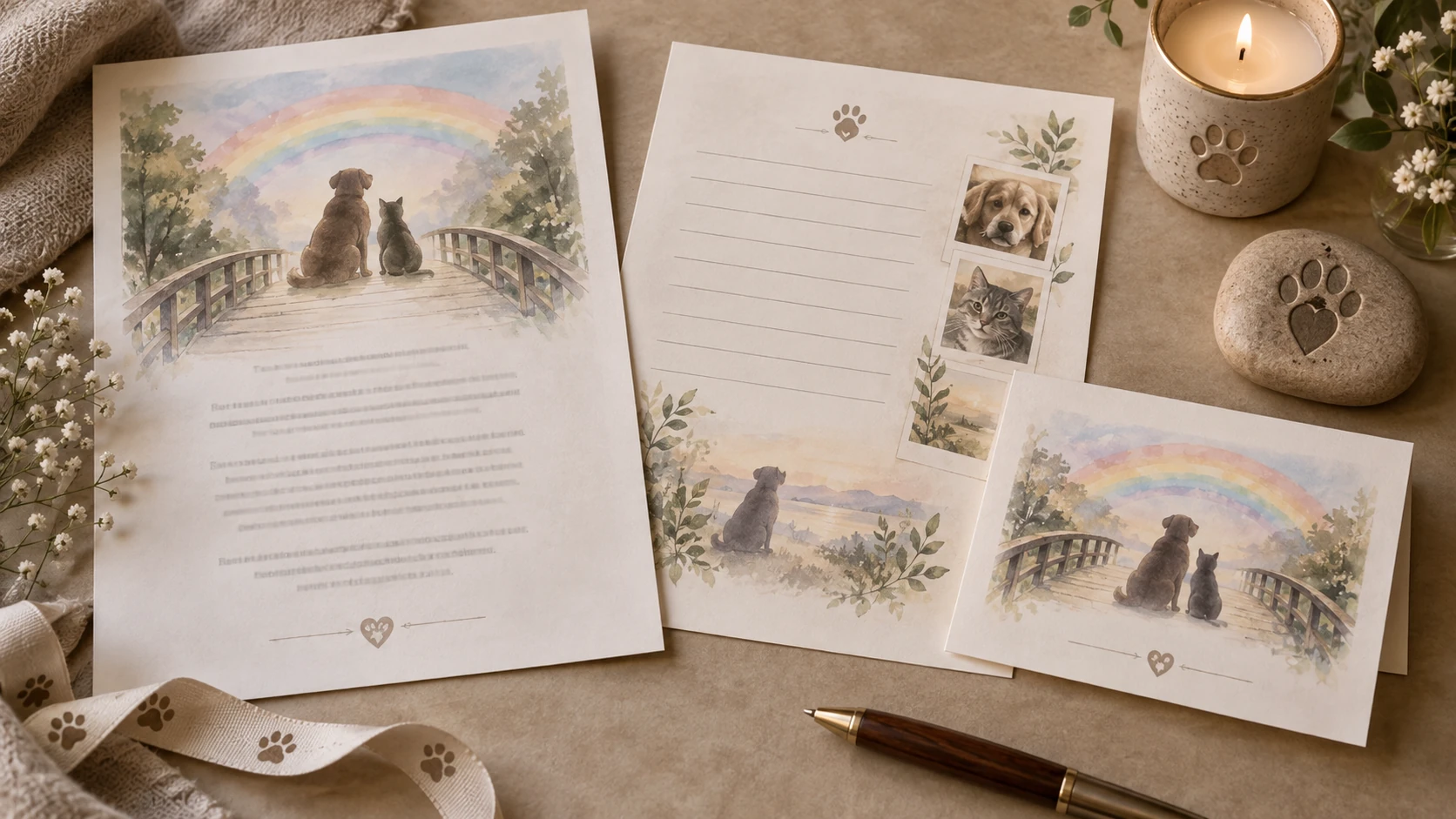
Free Rainbow Bridge remembrance resources
Offer more than one PDF so visitors can choose a format that fits the moment. Keep every resource quiet, printable, easy to understand, and consistent with the PetLoss.net visual system.
- 3-Part Meaning printable — Restoration, Remembrance, Reunion in one page.
- 8×10 remembrance print — a simple framed keepsake for a memorial corner.
- US Letter reflection sheet — prompts for writing a favorite memory, a thank-you, or a goodbye.
- 5×7 sympathy-card insert — a gentle companion resource for someone supporting a grieving friend.
- Candle ritual card — a short remembrance ritual with space for the pet’s name.
- Phone wallpaper — a restrained olive-and-parchment remembrance design.
Rights review: do not reproduce the full poem in downloadable or commercial assets until permitted-use and reproduction rights have been reviewed. The resource kit can be built around PetLoss.net’s original interpretation, prompts, and visual framework.
Watch or listen: the story and meaning of the Rainbow Bridge
Reserve this space for a calm 60–90 second explainer covering the poem’s origin, why it resonates with pet families, and the Restoration → Remembrance → Reunion framework. Use slow, natural meadow imagery and captions. Keep music optional and low-volume.
Accessibility: provide captions and a full transcript below the player. Avoid reading the full poem in the video until reproduction rights have been reviewed.


Create a personal Rainbow Bridge tribute
The poem is shared by millions of families, but your pet’s story is uniquely yours. Add their name, a photograph, and a few memories you never want to lose, then create a personal remembrance to keep or share with family.
Meaningful ways to use the Rainbow Bridge poem
At a pet memorial or celebration of life
Read a short passage aloud, place a remembrance card beside a favorite photograph, or use the poem as the starting point for sharing one story about your pet. For more ideas, explore gentle pet memorial ideas.
During a candle ritual
Some families say their pet’s name, share one memory, and sit quietly for a moment. PetLoss.net’s Candle Sanctuary is designed for this kind of simple remembrance.
When supporting a grieving friend
A short personal note often means more than a generic condolence. Pair the resource with one specific memory or quality you appreciated about their pet. See what to write in a pet-grief card.
As a starting point for a personal tribute
If the poem expresses part of what you feel but not the whole story, use the Rainbow Bridge Tribute Maker to add the pet’s name, photo, and personal memories.

For veterinary clinics, shelters, and pet-loss professionals
If you support families after the death of a pet, you are welcome to link to this page as a free educational and remembrance resource. The goal is to give families one calm place to read the poem, understand its history and meaning, and choose an optional next step.
Professional resource pack — reserved
- One-page client handout with QR code to this page
- PetLoss.net 3-Part Meaning infographic
- Short website resource description
- Aftercare-email paragraph
- Print-friendly reference sheet
Suggested website description:
“PetLoss.net’s Rainbow Bridge resource explains the poem’s origin and meaning and offers gentle remembrance resources for families after the loss of a companion animal.”
Linking is optional. Do not make a link a condition of receiving or using a free resource.
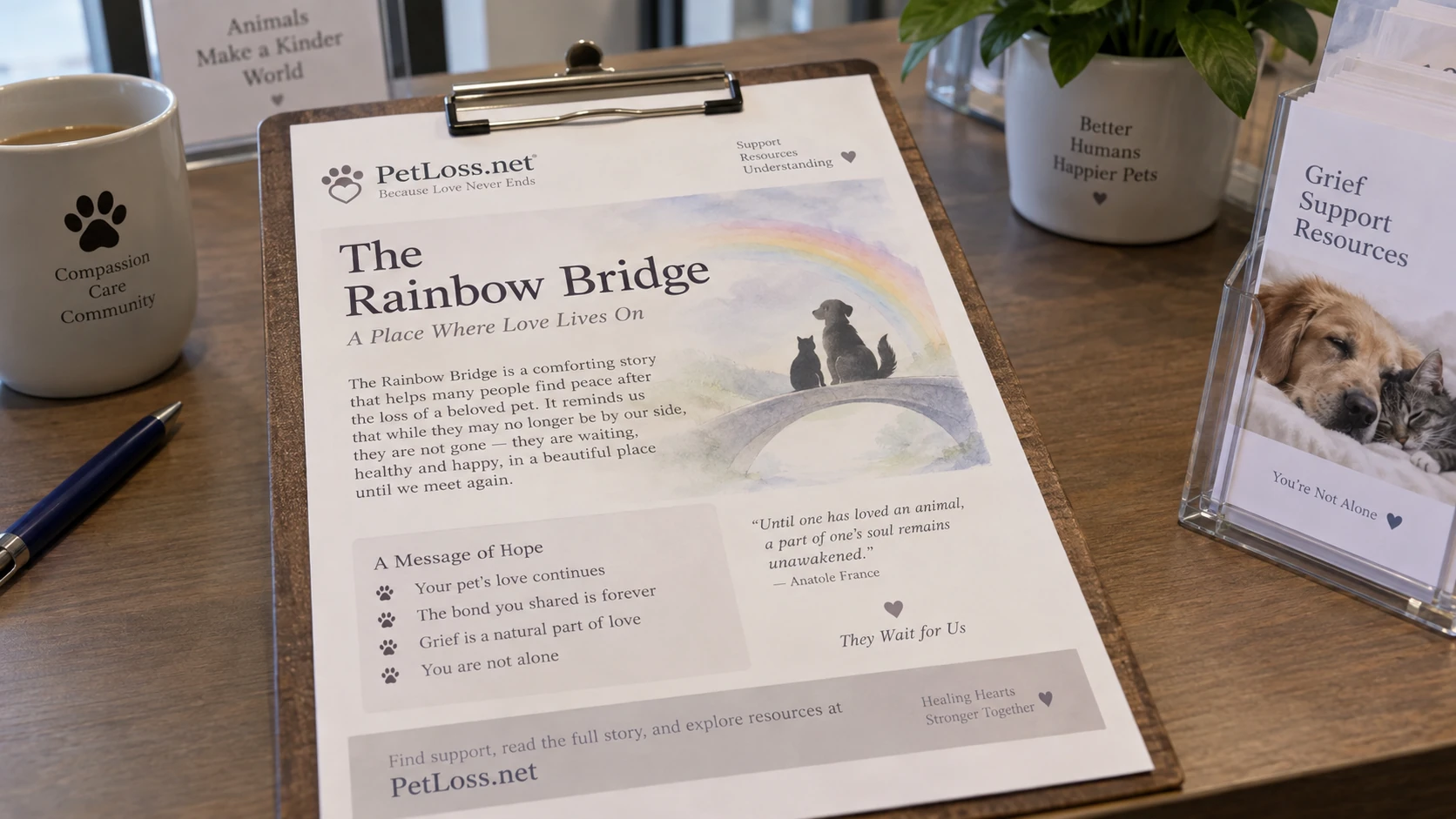
Continue with the support you need
- My Dog Has Died — What Do I Do Now? — practical first-hours guidance after a loss.
- Pet Memorial Ideas — gentle ways to remember a beloved pet.
- Rainbow Bridge Tribute Maker — create a personal remembrance.
- Pet Grief Card Messages — thoughtful words for supporting someone after a pet dies.
- Candle Sanctuary — a quiet ritual of remembrance.
- Pet Memorial Wall — visit and remember pets whose stories are being kept close.
Frequently asked questions about the Rainbow Bridge
Who wrote the Rainbow Bridge poem?
Edna Clyne-Rekhy wrote the poem in Scotland in 1959 after the death of her Labrador, Major. The poem circulated without her name for decades; research tracing the authorship was reported by National Geographic in 2023.
What does “crossed the Rainbow Bridge” mean?
It is a gentle way of saying that a pet has died, based on the poem’s image of companion animals waiting in a peaceful meadow before a future reunion.
Is the Rainbow Bridge only for dogs?
No. The poem refers broadly to animals and pets. Families use the Rainbow Bridge idea when remembering cats, rabbits, horses, birds, and other companion animals as well as dogs.
Is the Rainbow Bridge a real place?
The Rainbow Bridge is a consoling image rather than a location that can be scientifically verified. Some people understand it spiritually, some symbolically, and others simply as a story that helps them picture a beloved pet healthy and at peace.
Can I use the poem at a pet memorial?
Many families choose it as part of a home memorial or celebration of life. If you reproduce the full text in a printed program, downloadable file, or commercial product, review the relevant reproduction rights first.
Can I download something printable?
This page reserves space for PetLoss.net remembrance resources such as the 3-Part Meaning printable, a reflection sheet, a candle ritual card, and a sympathy-card insert. Each asset should be published only after rights, accessibility, and print QA are complete.
How can I make a Rainbow Bridge tribute personal to my pet?
Use the Rainbow Bridge Tribute Maker to combine your pet’s name, photo, and memories into a personal remembrance.
Sources and editorial notes
- National Geographic — The “Rainbow Bridge” has comforted millions of pet parents. Who wrote it?
- Society for Companion Animal Studies — The Rainbow Bridge Poem
Editorial review: verify authorship wording, reproduction permissions, all internal links, media rights, captions, and downloadable assets before publication. Planned review cycle: at least annually or whenever a cited source or linked resource changes.
A place for love to go.
Keep their name, story, and memory close
If reading the Rainbow Bridge brings someone to mind, PetLoss.net offers a quiet place to remember them—through a memorial, a shared story, or a simple candle.
